
Phillip’s story contains some medical terms which we have explained in the footnote section below his story.
Phillips’s experience, in his own words

I received chemotherapy and radiotherapy for anal cancer. I also have polycythaemia vera (PV), a rare blood cancer, and a pacemaker. I’m two years out.
I run every day. A few months ago, I started developing balance issues and leg weakness. Eventually, during a blood test, I learned that I was B12 deficient, and I developed anaemia and nerve damage in my legs. My B12 levels are now normal with monthly injections, but my legs are still weak and wobbly.
A recent lumbar spine MRI revealed that my bone marrow in my pelvic region no longer produced red blood cells, and fat has moved into the pelvic area. For two years, the haematologist said that all my blood counts were normal because they were suppressed by the radiation. Now, at least I know it’s worse, with the pelvic region not producing those red blood cells. PV is a cancer that causes the overproduction of red blood cells. With this problem [caused by radiotherapy], my counts look normal, but I still have PV.
The anal cancer treatment also left me with intestinal scarring. I don’t know how this will continue to affect me.
I have a pacemaker for total heart block and Atrial fibrillation (AFib), [which developed due to the] anal cancer, its treatment, and PV. I don’t know what to do or what to expect.
| Footnote information | |
| Polycythemia vera (PV) | PV is a slow-growing blood cancer where bone marrow produces too many red blood cells, causing thickened blood and an increased risk of blood clots. |
| Magnetic Resonance Imaging (MRI) | is a non-invasive medical scan that uses strong magnetic fields and radio waves to produce detailed, cross-sectional images of organs and soft tissues. |
| Atrial fibrillation (Afib) | is a type of heart rhythm problem where your heartbeat is irregular. |
Support for you
 Living with Pelvic Radiation Disease (PRD) can feel isolating, but connecting with others who understand can make a real difference. Our online community offers a safe space to share experiences, ask questions, and find peer support from people who truly get it.
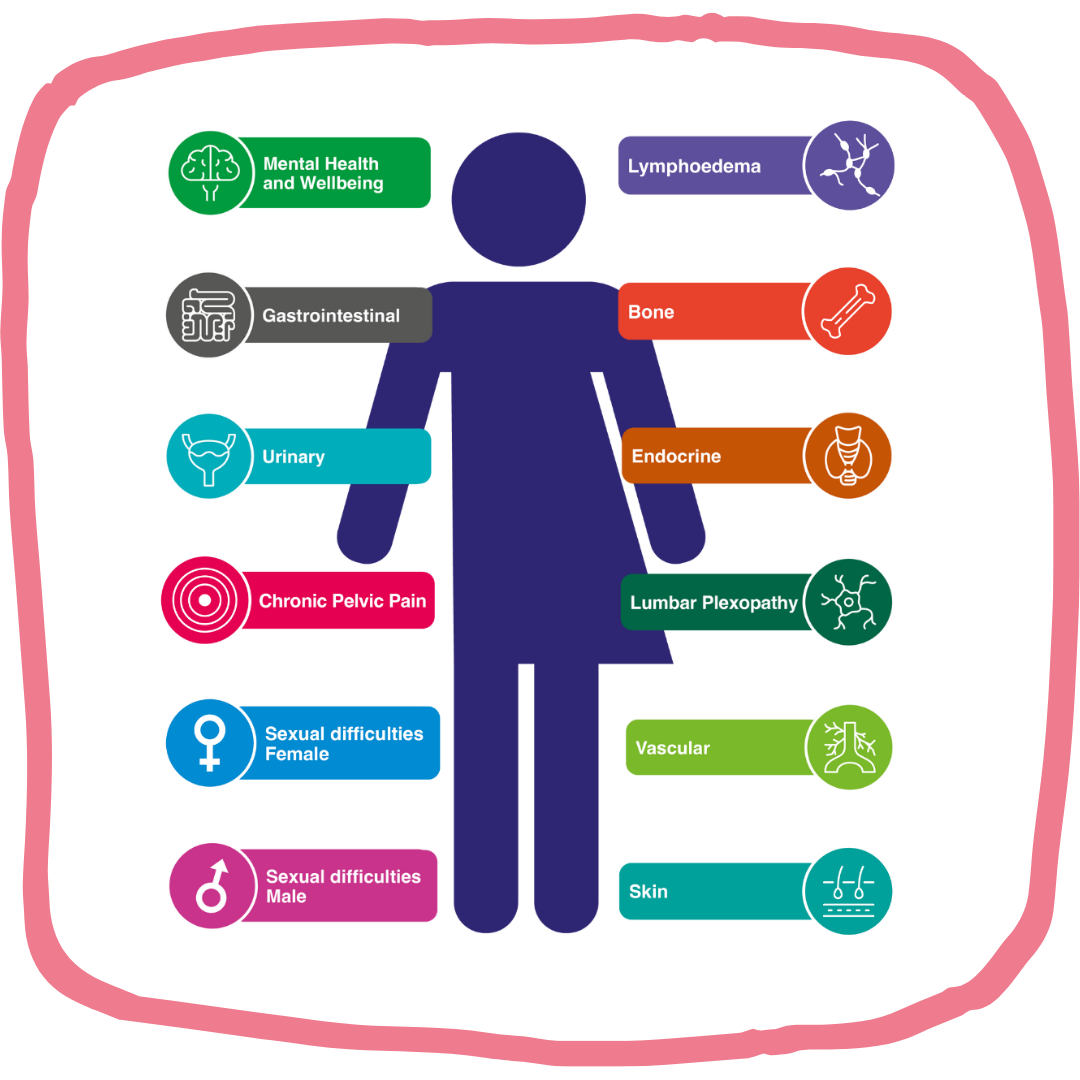 The PRD Best Practice Pathway – Designed for healthcare professionals caring for those with Pelvic Radiation Disease, the PRD Best Practice Pathway is also a valuable resource for people living with PRD, seeking to understand their care options and advocate for better support.
If you’re feeling overwhelmed, struggling with your mental health, or having thoughts of suicide, please know that you’re not alone and support is available. You can find help through the links below, or by speaking to your GP or a trusted healthcare professional.
- You can find a range of support options at Mind if you are struggling with your mental health.
- If you are struggling to cope you can contact the Samaritans free helpline, any time day or night on 116 123.
- For urgent medical concerns, contact NHS 111.
last modified 6th May 2026